Global money movement you can stake your reputation on
Benevity disburses funds to 2.5 million verified nonprofits across 160+ countries in as little as 14 days — with a built-in compliance engine that handles sanctions screening, fraud monitoring and cross-border regulations automatically. For enterprise impact leaders, it's the infrastructure that makes global giving trustworthy, traceable and fast.


How does Benevity distribute funds to nonprofits globally?
Benevity runs automated weekly disbursement cycles across all donation types — payroll giving, one-time donations, matching gifts and corporate grants — reaching 2.5 million verified nonprofits across 160+ countries and 100+ currencies. Every transaction runs through a built-in compliance engine, giving your Finance and CSR teams a full audit trail from commitment to completion.
Global giving isn't simple. Cross-border currencies, local regulations and stakeholder expectations create risk at every step. Benevity's disbursement infrastructure handles it end to end — so you can focus on the purpose of your program, not its plumbing.
Whether it's payroll giving in the UK, EFTs in Japan or FCRA-compliant transfers in India, Benevity localizes to meet nonprofit needs — with no enrollment fees and no third-party payment partners required.
Global giving isn't simple. Cross-border currencies, local regulations and stakeholder expectations create risk at every step. Benevity's disbursement infrastructure handles it end to end — so you can focus on the purpose of your program, not its plumbing.
Whether it's payroll giving in the UK, EFTs in Japan or FCRA-compliant transfers in India, Benevity localizes to meet nonprofit needs — with no enrollment fees and no third-party payment partners required.

See what's driving purpose today
From granting and global giving to employee engagement, uncover the insights defining the future of corporate purpose.
Request a personalized demoHow fast does Benevity get money to nonprofits?
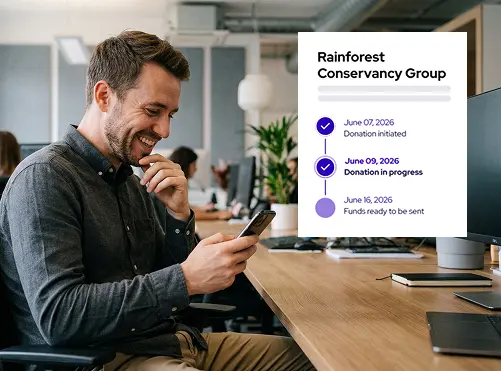
Benevity disburses funds in as little as 14 days through automated weekly disbursement cycles — covering all donation types and all eligible countries. That's significantly faster than the industry standard of 30 days or more. Real-time status tracking means your Finance and CSR teams always know where funds are, from the moment a donation is made to the moment it lands.
Speed matters most when it matters most. During the Texas floods, Fox Corporation used Benevity to move $7M to verified nonprofits in one week — connecting corporate donors with active, validated causes at the moment communities needed help.
Unlike region-limited platforms, Benevity's 14-day model applies to all donation types, across all eligible countries — not just select markets or enrolled payment partners.
Speed matters most when it matters most. During the Texas floods, Fox Corporation used Benevity to move $7M to verified nonprofits in one week — connecting corporate donors with active, validated causes at the moment communities needed help.
Unlike region-limited platforms, Benevity's 14-day model applies to all donation types, across all eligible countries — not just select markets or enrolled payment partners.
Global reach, local impact
Fund delivery to 2.5M nonprofits across 160+ countries and over 100 currencies. Whether it's payroll giving in the UK or EFTs in Japan, we localize to meet nonprofit needs.


Enterprise-grade trust
Every disbursement passes through Benevity's four-layer due diligence framework — Validation, Verification, Vetting and Investigation — including daily OFAC/SDN sanctions screening, government registry syncs, country-law-aware disbursements and NGOsource Equivalency Determination for cross-border transactions.
The result: a 99% payment success rate and ongoing fraud monitoring built for enterprises that can't afford errors.
The result: a 99% payment success rate and ongoing fraud monitoring built for enterprises that can't afford errors.
For nonprofits: receive funds with confidence
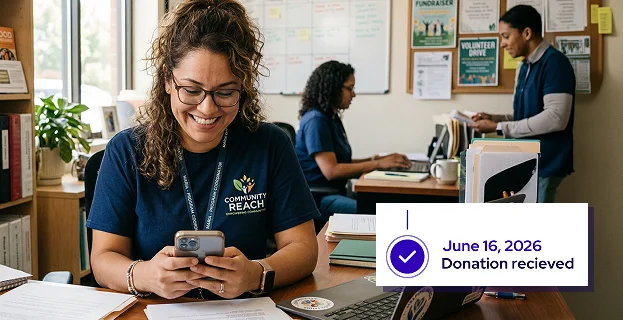
Nonprofits receive funds reliably with transparent tracking and timely disbursements, while rigorous verification ensures your employees give with peace of mind and grantees get support when it matters most.
How Benevity helps
Benevity has the world’s most responsive social impact infrastructure, with a focus on security, speed and scale. By integrating weekly disbursement cycles with our industry-leading global compliance engine, we enable companies to move money at the speed of human generosity — ensuring funds reach nonprofits in as little as 14 days with the security, transparency and scale your programs need.
When it matters most, speed and trust work together. See how Fox Corporation used Benevity to securely mobilize $7M in one week during the Texas floods — connecting corporate donors with verified nonprofits at the moment of need.
When it matters most, speed and trust work together. See how Fox Corporation used Benevity to securely mobilize $7M in one week during the Texas floods — connecting corporate donors with verified nonprofits at the moment of need.

Global money movement FAQs
How does Benevity ensure compliance on global disbursements?
How fast does Benevity disburse donations to nonprofits?
What is a Donor Advised Fund (DAF), and how does it enable faster disbursements?
Does Benevity support global nonprofit disbursements in all countries?
How does Benevity protect against fraud in charitable disbursements?
What makes Benevity different from other nonprofit disbursement platforms?

See Benevity in action
Unlock your impact potential. Schedule a personalized demo to explore our platform’s world-class capabilities.